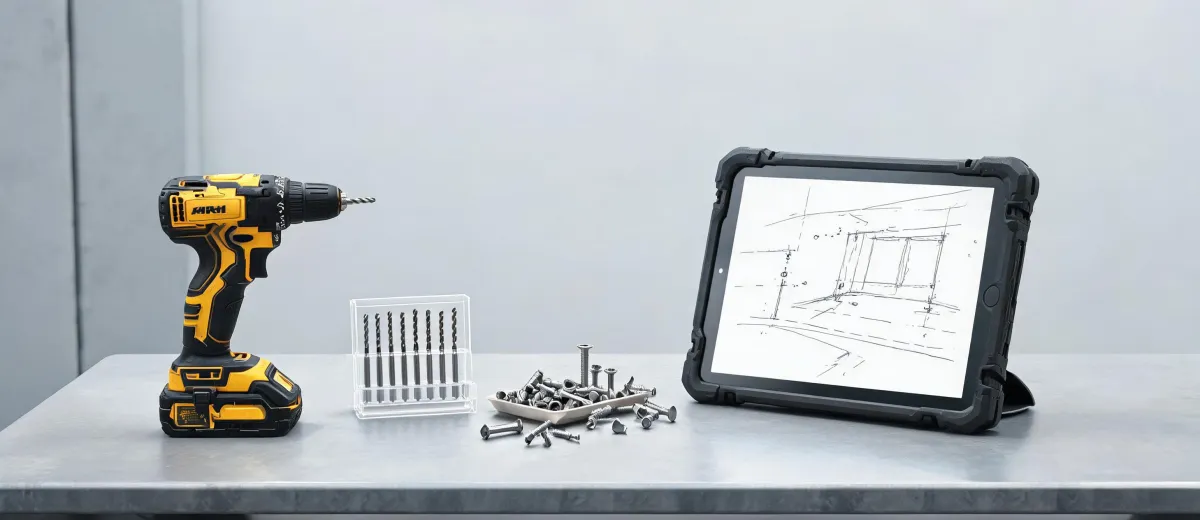
In 2020, I took over purchasing for a 90-person construction services and maintenance company. I manage roughly $180,000 in annual orders across eight vendors, and I report to both operations and finance. I am not a full-time tool reviewer. I am the person who has to explain to finance why another hammer drill is worth the money and why a box of anchors should not be returned.
How I Frame This Comparison
If you are looking for the simple answer to the best hammer drill question, here is the honest one: it depends on what you are drilling and fastening. Since 2020, we have standardized on three related pieces of the system: Hilti concrete screw anchors, the Hilti TE2 hammer drill, and impact drivers for fastening. This article is the comparison I use before ordering any of them.
A tool comparison only works if the two options are actually trying to do the same thing. That is where most online arguments get messy. One person is mounting a handrail into concrete. Another is driving 5mm screws into steel framing. They both think they need a hammer drill. They do not need the same setting.
So I split the work into three A versus B comparisons:
- Drilling concrete holes: Hilti TE2 hammer drill versus an impact driver.
- Driving fasteners: impact driver versus a standard drill.
- Anchoring: Hilti concrete screw anchors versus expansion-style anchors.
The answers are not equally important. The drill and the anchor must match because a 5mm drill bit is not just a 5mm drill bit when the hole is going into concrete.
Dimension 1: Drilling with the Hilti TE2 hammer drill versus an impact driver
I have lost track of how many times someone asked if an impact driver can drill concrete. It cannot do anchor work reliably. No, wait—it can spin a bit through a soft block wall if you push hard, but it does not have the axial hammer action needed for a clean 5mm hole in structural concrete. The Hilti TE2 does. That is the main reason we buy it.
According to Hilti’s current product documentation (hilti.com, accessed January 2025), the TE2 is positioned as an SDS-Plus rotary hammer. I am not going to quote specifications here; verify them on the current page. What matters for my purchase orders is that the TE2 gives crews a dependable way to drill the exact hole depth before concrete screw installation.
Hilti product engineers do not classify the TE2 as a general-purpose drill. The distinction is not marketing. The hammer action moves the bit back and forward in the chuck while it rotates; that motion breaks concrete. An impact driver creates rotational impacts for screws, and a standard drill creates almost no hammering at all. The surprise to me was how many crews knew this and still carried the wrong tool because the right drill was in another truck.
When I write 5mm drill bit on an order, I have to be specific. For a concrete screw anchor hole, the bit should match the anchor manufacturer’s required diameter. A standard round-shank 5mm twist bit is fine for steel pilots. It is not the right tool for a TE2 concrete hole. The correct accessory is an SDS-Plus bit, and the correct drill is the TE2 or an equivalent rotary hammer. Simple.
Dimension 2: Fastening—Why use an impact driver over a drill?
The next step after drilling is driving the fastener. This is where the impact driver beats a drill for most of our work. The popular explanation is that an impact driver has more torque. Actually, the useful explanation is that an impact driver manages torque in rapid bursts, so the fastener keeps moving without binding the operator’s wrist or rounding the head.
Why use an impact driver over a drill? For me, it is because the driver does a better job on long anchoring screws and on 5mm hex-head screws that need to be set without changing the angle of the socket. A drill can drive them in soft material, but if a screw binds in a dense material, the drill kicks hard. The impact driver lets the force happen closer to the fastener.
Here is the part that catches some buyers off guard: an impact driver is not a replacement for a hammer drill. It is a replacement for the driving phase only. We still drill concrete anchor holes with the Hilti TE2, then switch to an impact driver with a hex socket to run the anchor. If somebody tells you to use an impact driver instead of a drill for every job, they are thinking about speed, not about who has to pay for damaged threads.
I wish I had tracked drilling errors by tool type more carefully. I can say anecdotally that we replaced more broken bits than broken anchors, which tells me the drilling stage is underrated.
Dimension 3: Hilti concrete screw anchors versus expansion anchors
Now we are at the part where I used to get the order wrong. I assumed that expansion anchors were the premium option because they expand inside the concrete. In reality, the choice has less to do with how strong the anchor sounds and more to do with the condition of the hole and the base material. If the hole is too shallow, too wide, or dirty, an expansion anchor can fail to set properly. A Hilti concrete screw anchor also depends on a precise hole, but the thread cuts into the concrete instead of relying only on an expansion clip at the bottom.
I don’t have hard data on industry-wide anchor failure rates. What I can say from our purchase history is that crews using a TE2 and a clean, accurately drilled hole have fewer callbacks on repetitive anchoring work than they did when we let whoever was on site pick the anchor style. That sounds like a drill problem, not an anchor problem. It is both.
Does that mean I order Hilti concrete screw anchors for everything? No. When an engineer specifies a wedge anchor or another expansion anchor with a load table, I buy exactly what the spec says. The advantage of Hilti concrete screw anchors for our company is consistency on medium-duty applications such as railings, conduit straps, and strut channel. The advantage disappears if someone orders an anchor size without checking the required 5mm drill bit or the required minimum embedment.
This is why I ask our Hilti rep for confirmation and use Hilti anchor engineering software when the application is not obvious. Hilti’s technical data makes clear that anchors are engineered products; you do not pick a concrete screw anchor by guessing. A good hammer drill starts with the right bit and the right spec. If you want a truly useful buying decision, put the Hilti TE2, the impact driver, and the anchors on the same page and ask which job is on the schedule.
What I Actually Order Now
After five years of doing this, my standard list has become simple:
- Hilti TE2 hammer drill for every truck that does concrete work.
- A 5mm drill bit in SDS-Plus when the anchor spec calls for it, plus spare bits in the toolbox.
- An impact driver for fastening, not drilling.
- Hilti concrete screw anchors in the sizes confirmed by Hilti’s technical data for the specific mounting job.
If a new project is mostly mounting steel to concrete, the TE2 goes on the order first. If the crew is doing work where 5mm screws go into steel framing, an impact driver would be the priority. No single tool is the best hammer drill for everyone. The best hammer drill, like the best anchor, is the one that matches the work and the drill bit.
In 2024, our vendor consolidation project forced me to explain to our leadership why we did not buy the cheapest hammer drill. The answer was not brand loyalty. It was system cost: the TE2, a correct 5mm SDS bit, and Hilti concrete screw anchors work as a package. If you start with a cheap drill and a random bit, the anchor no longer performs to spec. The drill motor might be fine. The hole is where the job is won or lost.
The best buying advice I can give is: do not let a tool review make the choice for you. Choose the tool you need. That is why the Hilti TE2 still makes sense for us.

Leave a Reply