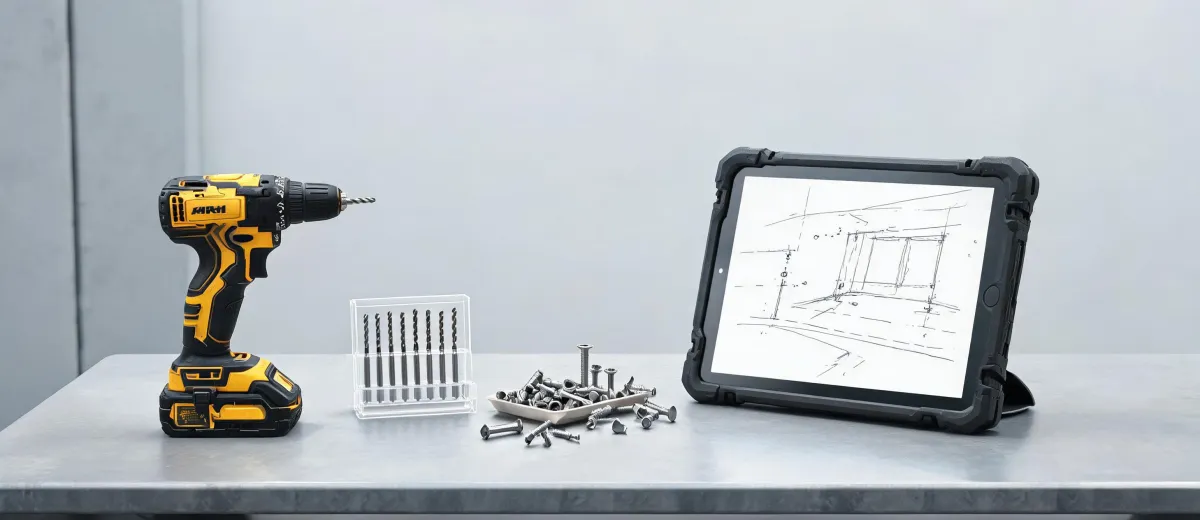
对比框架:紧急维修包不是工具越多越好
I'm an emergency logistics lead at a construction supply company. I've handled 300+ rush orders in 9 years, including same-day turnarounds for contractors who call after a concrete anchor fails an inspection. So when I compare Hilti drop-in anchors and Hilti zip screws with a 280 piece mechanics tool set, I'm looking at what actually gets a crew back to work.
When I'm triaging a rush job, I don't start with the catalog. I start with three questions: How many hours until the crew needs it? What base material are we fixing? And what happens if the first fix fails? That's why the real comparison isn't Hilti vs. a big tool set. It's Hilti drop-in anchors and Hilti zip screws vs. a 280 piece mechanics tool set—and then where a small angle grinder DWE402 and hose clamp pliers actually belong.
Here's the framework I use: speed to first fix, coverage vs. depth, and total cost transparency. If you're comparing emergency kits, those three dimensions will tell you more than any spec sheet.
Everything I'd read about emergency kits said more tools equals more readiness. In practice, I've watched a 280-piece set sit untouched while one box of Hilti drop-in anchors and a handful of Hilti zip screws got a concrete repair back online before the general kit was even organized. Not because the general set was bad—because it was the wrong category.
维度 1:速度到首次修复——Hilti Drop-In Anchors and Zip Screws vs. 280-Piece Set
In an emergency, speed isn't about how fast you can open a case. It's about how fast you can make a safe, approved connection. Hilti drop-in anchors are designed for concrete: drill, clean, set, torque. Hilti zip screws are for fastening in metal or light gauge applications where you need a self-drilling, self-tapping solution. If the job is concrete or steel, those are direct-path tools.
A 280 piece mechanics tool set is broad. It'll give you sockets, wrenches, bits, maybe hex keys. That's useful for mechanical assembly, pump repairs, or equipment maintenance. But it usually doesn't include concrete anchors, SDS drill bits, or the load data you need for a structural fastening. So the comparison isn't apples to oranges; it's a specialized fastening system vs. a general mechanical repair kit.
My take: if the emergency is a concrete anchor pull-out, the 280-piece set is a backup, not the first line. If the emergency is a seized bolt on a pump, the reverse is true.
As of January 2025, Hilti publishes technical data and approval information for its anchoring systems through its online design tools and product pages. For any anchor, verify current load values and base-material approvals before specifying. For general tools, check the manufacturer's current documentation, because included pieces and specs can change.
维度 2:覆盖广度 vs. 作业深度——DWE402 and Hose Clamp Pliers
This is where people get tripped up. A small angle grinder DWE402 is a general-purpose cutting and grinding tool. It can cut rebar, pipe, threaded rod, or metal brackets. It's not an anchoring system. It doesn't replace Hilti drop-in anchors. But on an emergency job, having a small grinder can mean the difference between modifying a bracket in 10 minutes and waiting two hours for a machine shop.
And what are hose clamp pliers? They're a specialty tool for installing and removing spring-style or wire hose clamps, especially in tight engine compartments or cooling lines. They're not for every job. But when you need them, a pair of adjustable pliers usually damages the clamp or slips. That's a perfect example of depth beating breadth: one dedicated tool solves a painful, specific failure.
From the outside, a 280-piece mechanics tool set looks like complete coverage. The reality is that coverage without depth can leave you missing the one tool that actually stops the leak or sets the anchor. That's why I carry both categories: a general mechanical set for breadth, and targeted tools for the jobs that can't wait.
维度 3:总成本透明度——Hidden Costs in Emergency Tooling
Transparent pricing beats hidden fees and last-minute add-ons. Same rule applies to emergency tool kits. The sticker price of a 280-piece set looks efficient. Then you discover it doesn't include the impact-rated sockets you need, the SDS bits for the rotary hammer, or the anchor approval data for a structural connection. Suddenly you're paying overnight shipping for three separate items—and you're still not sure the anchor is approved for the base material.
With something like Hilti drop-in anchors or Hilti zip screws, the upfront question should be: what's included, what's approved, and what else do I need to finish the fix? I've learned to ask 'what's NOT included' before 'what's the price.' The vendor who lists all fees and required accessories upfront—even if the total looks higher—usually costs less in the end, because you're not paying rush fees twice.
I don't have hard data on how many emergency callbacks are caused by missing bits or incompatible anchors. But anecdotally, across the rush orders I've coordinated, the failures I remember weren't from tool quality. They were from missing pieces nobody flagged until the crew was already on site.
选择建议:What to Buy for Which Emergency
Here's how I'd divide it:
- Concrete or structural fastening emergency: Go with Hilti drop-in anchors and the correct carbide bits. Add Hilti zip screws if you're also fastening light gauge metal or need a quick self-drilling solution. Verify load data and base material before you drill.
- General mechanical breakdown: A 280 piece mechanics tool set is the right starting point—sockets, wrenches, bits, extensions. It won't replace a concrete anchoring system, but it'll handle pumps, conveyors, and equipment bolts.
- Cutting, grinding, or bracket modification: A small angle grinder DWE402 is a practical emergency tool. Keep the right discs for metal, and don't ask it to do a concrete anchor's job.
- Hose, coolant, or fluid line repair: Carry hose clamp pliers. They're cheap insurance against damaging a clamp you can't easily replace at 2 a.m.
If you're building one kit, don't choose between Hilti and a general mechanics set. Choose based on the failure you're most likely to face. For concrete and steel fastening, Hilti is the specialized path. For broad mechanical repair, the 280-piece set earns its space. For cutting and hose clamps, add the grinder and pliers as targeted problem-solvers.
Look, the best emergency kit isn't the one with the most pieces. It's the one where every piece has a job you've actually seen fail. That's the standard I use—and it's kept more jobs on schedule than any oversized case ever did.

Leave a Reply