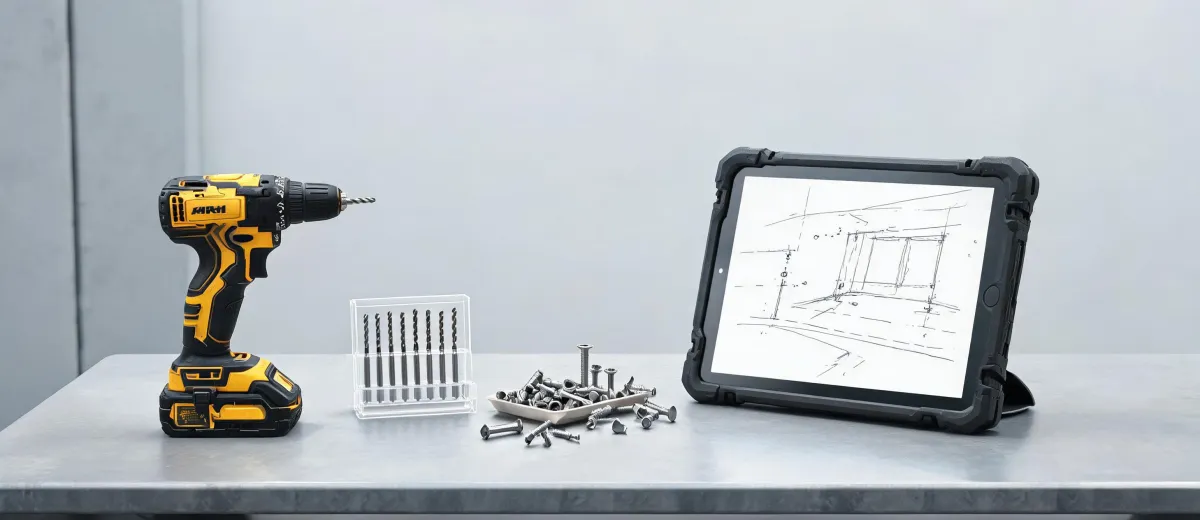
If you're about to choose concrete anchors for threaded rod based only on the rod diameter, stop. That shortcut cost me about $4,300 in rework plus a missed deadline on one project. The right anchor depends on the concrete condition, edge distance, load path, and installation quality. Hilti has anchors for most of these situations, but you have to know which situation you're in before you buy.
I'm not a structural engineer. I'm closer to the guy who gets called in after someone installed something with the wrong fastener. I've been doing construction and maintenance work since 2014, handling service orders in older buildings and small commercial shops. In 11 years I've documented 19 fastener mistakes that came from ordering too fast and verifying too late. They cost roughly $23,000 in wasted material, labor, and credibility. The most useful lesson came from threaded rod.
The $4,300 Anchor Mistake That Changed My Checklist
In September 2022, my crew installed a row of ceiling hangers for a small equipment platform. We used 1/2-inch threaded rod and wedge anchors of the same nominal size. The installation looked clean: straight holes, clean threads, all anchors torqued to the number on the box. The inspector asked two questions I couldn't answer. What was the edge distance? Was the concrete cracked?
The holes were close to a construction joint, and the slab had hairline cracks I hadn't treated as relevant. Wedge anchors hold by expanding against the concrete. When the concrete is cracked or the edge is close, expansion behavior changes. We had to remove all 14 hangers and reinstall them with an adhesive anchoring system. It passed the inspection. It also cost three extra days and a big trust hit.
Now my pre-install checklist starts with four questions: Is the concrete cracked or solid? How close is the nearest edge? What load is actually hanging on this? Who approves the calculation? If I can't answer all four, I don't order the anchor yet.
Hilti Has Anchors for Different Concrete Conditions
Most people hear Hilti and think power tools. The first time a contractor friend told me Hilti has anchors for almost every base material, I nodded and kept checking drill prices. Then I actually looked at the anchor catalog. He was right. Hilti has anchors for concrete, masonry, steel, and special use cases. Some are mechanical expansion anchors. Others are adhesive systems that use a resin plus a threaded rod.
Hilti has anchors that are approved for cracked concrete and others that assume uncracked concrete. That label is not a sales detail. It affects whether the anchor will behave the way your load calculation expects.
Concrete anchors for threaded rod are not just rod plus a nut. The rod carries the load only if the anchor sleeve or resin transfers that load into sound concrete.
In an adhesive anchor system, you typically push a threaded rod into a hole filled with structural adhesive. Hilti calls those rods HAS rods. That's why a simple search for concrete anchors for threaded rod can lead you to both wedge anchors and adhesive systems. They both work. They work under different conditions.
The other thing I learned is that an adhesive anchor doesn't forgive a dirty hole. The manufacturer's load data assumes you cleaned the hole with the specified brush and air. If you don't, you're not following the test conditions, and the performance number goes out the window.
Hilti Cordless Drill: My Honest Take
People search for Hilti cordless drill because they think the drill is the whole answer. A drill driver is a great tool for wood and metal. When you're putting anchors into concrete, you often need a rotary hammer, not a general-purpose cordless drill. That's true no matter which brand you buy.
If you make money with your tools, the Hilti cordless drill system can be worth the cost. I bought into the Nuron 22V platform because my drills, rotary hammers, and impact tools share batteries. On a real job, that matters more than the marketing spec. If you're a DIYer doing a handful of projects, then a Hilti cordless drill is probably overkill. That's not a reason to avoid it; it's just a bad use of money. Use a properly rated mid-range drill for occasional work and save the extra budget for anchors or an engineer review.
Search Hilti cordless drill reviews and you're reading opinions written for professionals. If your project doesn't involve daily drilling, adjust the recommendation down.
Nail Guns and Pressure Washer Prices Have the Same Trap
People type which nail gun is best for DIY and expect one model recommendation. I usually answer with a category: an 18-gauge brad nailer for trim and general repairs, a framing nailer for structure, a pin nailer for delicate woodwork. The best DIY nail gun is the one that fits the nail size and material you'll be using most. There's no universal winner because a brad nailer can't frame a wall and a framing nailer is too heavy for crown molding.
The same mistake shows up in a 3300 psi pressure washer price search. You'll see a big price range for similar psi numbers. As of early 2025, retail listings for 3300 psi gas pressure washers vary widely, so verify current pricing before you buy. Power washing doesn't start and end with psi; flow rate matters too. If two machines have the same psi but different water flow, they'll clean differently. A cheaper pressure washer may be perfectly fine for light use. A more expensive one usually costs more because of the pump and engine, not the sticker number.
This is the transparency lesson I've learned the hard way: ask what's not included before you ask for a discount. A clear complete price is worth more than a low price with missing details. The vendor who lists all costs up front is usually the one who costs less in the end.
Where I Stop Advising
This article is not an anchor sizing chart. If your project carries anything overhead, supports people, or requires an engineer's stamp, my opinion doesn't count. Get a licensed engineer to review the base material, anchor type, spacing, and embedment. Use manufacturer data from Hilti's published reports and ICC-ES reports. The price of engineering is much lower than the cost of cutting anchors out of concrete.
And if you're buying a tool just because it's the brand a contractor uses, ask yourself how many hours a month you'll actually run it. If the answer is less than one, a Hilti cordless drill or a pro framing nailer is a want, not a need. There is nothing wrong with wants, but don't call it a cost-saving decision.

Leave a Reply