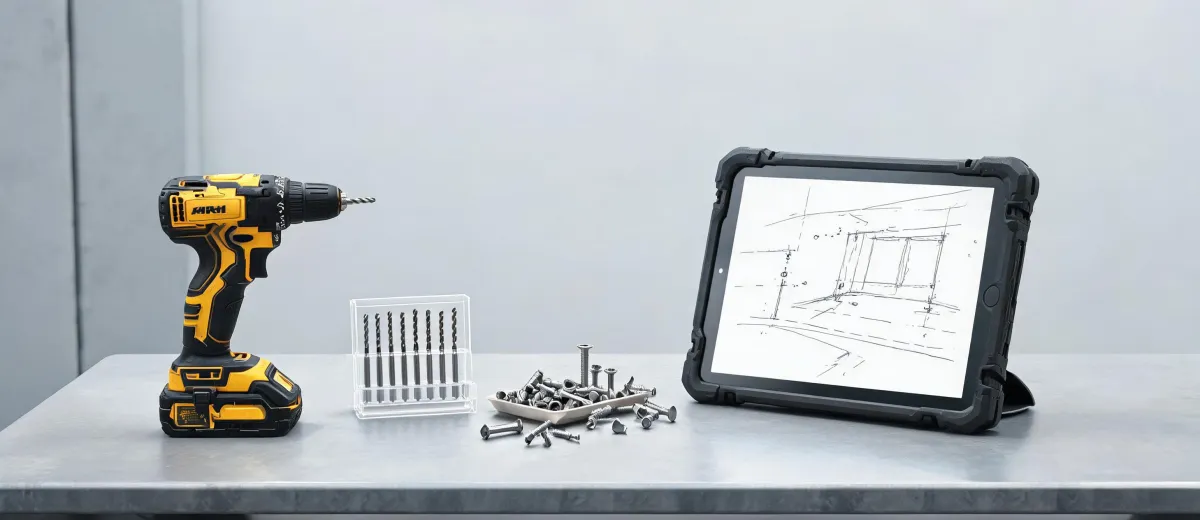
How I compare tools before they reach a job site
I'm a quality/brand compliance manager at a construction supply company. I review every tool and anchor order before it reaches customers—roughly 300 items a month. In 2024, I rejected about 11% of first deliveries because specs didn't match what we ordered. So when someone asks me to compare a Hilti TE 17 hammer drill against a cordless drill, or whether to buy a Hilti set tool and drill bit combo, I don't start with brand loyalty. I start with the task.
Here's the framework I use: task match, bit/accessory compatibility, and total risk. I'll also explain where hammer drill bits fit, what the use of a cordless drill really is, and why a manual 3-way ball valve is not a Hilti problem—it's a specialist problem.
If you've ever had a crew try to drill a 1/2-inch anchor hole with a cordless drill in hammer mode, you know that sinking feeling. The hole gets done. The tool and the bit pay for it later.
Dimension 1: Task match—Hilti TE 17 vs. cordless drill
The Hilti TE 17 hammer drill is built for concrete and masonry. It's in the SDS Plus rotary hammer class. That matters because a rotary hammer uses a piston mechanism to strike the bit while it rotates. A cordless drill with a hammer mode uses two clutch plates that ratchet against each other. It's a useful feature for light masonry, but it's not the same animal.
What's the use of a cordless drill? It's the generalist: drilling wood, metal, plastic, and light masonry; driving screws; running hole saws; mixing small batches with the right paddle. It's the tool you grab for 80% of everyday tasks. But if you're setting anchors in concrete, the TE 17 is the right call. The hole is faster, cleaner, and closer to spec. That's not a knock on cordless drills. It's just task matching.
When I compared our TE 17 and an 18V cordless drill side by side on a recent anchor layout, I finally understood why the hammer mechanism is not a marketing word. The TE 17 drilled 3/8-inch holes in cured concrete in a fraction of the time. The cordless drill got through, but the bit was hot and the hole was ragged. For anchor work, ragged holes cost you. You end up with more dust, more bit wear, and sometimes a hole that fails a gauge check.
Conclusion for dimension 1: Use the TE 17 for concrete and masonry anchor holes. Use a cordless drill for wood, metal, driving, and light masonry. If your day is mostly concrete, don't pretend a cordless drill is a rotary hammer.
Dimension 2: Hammer drill bits and the Hilti combo set
Hammer drill bits are not interchangeable. SDS Plus bits have a slotted shank that locks into a rotary hammer chuck. Round shank masonry bits fit a standard drill chuck. Hex shank bits fit impact drivers. If you put the wrong bit in the wrong tool, you get poor transfer of energy, premature wear, and sometimes a stuck bit.
The Hilti set tool and drill bit combo exists to remove that mismatch. You get the tool and a set of bits designed for the chuck and the application. In quality terms, that's a big deal. A combo set reduces the chance that someone grabs a worn bit, a bent bit, or a bit with the wrong tip geometry.
But I have mixed feelings about combo kits. On one hand, they're convenient and often better value than buying everything separately. On the other, you pay for bits you may never use. If your work is 90% 3/8-inch anchor holes, a kit with 12 sizes might be overkill. Here's something vendors won't tell you: the first combo quote is rarely the final config. Ask your rep to swap sizes or build a custom kit. A good supplier will do it. A great one will tell you which bits you actually need.
Also check the bit tip. Carbide tips are not all the same. For concrete, you want a bit designed for hammer drilling, not a masonry bit with a pretty coating. And yes, inspect the SDS Plus shank for wear. A worn shank slips, and a slipping bit can ruin the chuck.
Conclusion for dimension 2: If you run a TE 17, stay in the SDS Plus ecosystem. A Hilti combo set is a smart starting point if you need a range of sizes. If you need two sizes, buy two good bits instead of a big kit.
Dimension 3: The manual 3-way ball valve detour
Now the keyword that doesn't belong in a tool comparison: manual 3-way ball valve. A manual 3-way ball valve controls flow—diverting, mixing, or shutoff in a piping system. It has nothing to do with hammer drills or cordless drills. And that's the point.
I'd rather work with a specialist who knows their limits than a generalist who overpromises. Hilti is a specialist in power tools, anchoring systems, and related accessories. A manual 3-way ball valve is a fluid control product. If you need one, you should be talking to a valve distributor or a piping supplier. Forcing a tool brand into that conversation is how you end up with the wrong port size, the wrong pressure rating, or the wrong seat material.
What most people don't realize is that 'one-stop shop' can be a trap. The vendor who says 'this isn't our strength—here's who does it better' earns my trust for everything else. That's the expertise boundary I look for. It doesn't make the tool brand weaker. It makes the recommendation stronger.
Conclusion for dimension 3: Keep the categories clean. Hilti for hammer drills, hammer drill bits, and anchoring tools. A valve specialist for a manual 3-way ball valve. Mixing them is not a comparison—it's a compliance risk.
Dimension 4: Total cost and quality risk
Price is not the same as cost. The TE 17 and a Hilti combo set cost more up front than a budget cordless drill and a pack of generic bits. But if you're drilling anchor holes all day, the cheaper setup can cost you in bit replacements, rework, and schedule delays. I don't quote prices here because tool pricing changes by region, kit, and service agreement. Verify current pricing with Hilti or your local rep.
On the jobsite, the hidden costs show up fast: a burned-out cordless drill, a wallowed-out anchor hole, a failed inspection, or a valve that leaks because someone ordered the wrong pressure class. In our Q1 2024 quality audit, we traced 18% of tool-related returns to wrong bit type for the application. Not defective tools. Wrong match.
So glad we standardized on SDS Plus for concrete anchor work. Almost went with a mixed bit drawer to save a few dollars, which would have meant crews grabbing whatever fit. Now every TE 17 kit has the right bits, and every order gets a spec check before it ships.
Conclusion for dimension 4: Buy the tool and bit system that matches the task. A combo set is cheaper than chaos. A specialist valve supplier is cheaper than a leak.
Selection guide: what I'd choose and when
If you're drilling concrete or masonry anchor holes: choose the Hilti TE 17 hammer drill and SDS Plus hammer drill bits. A Hilti set tool and drill bit combo makes sense if you need multiple sizes and want a verified match.
If you're doing general drilling and driving: choose a cordless drill. That's the use of a cordless drill—wood, metal, plastic, screws, and light masonry. Keep a small masonry bit set for occasional brick or block. Just don't use it as your concrete anchor tool.
If you need a manual 3-way ball valve: go to a valve specialist. Check port size, pressure rating, body material, and seat material against your line. Don't let a tool catalog solve a flow-control problem.
If you're building a kit: start with the three sizes you use most, then add. That's been my experience with anchor crews, though I should note we mostly run 3/8 to 5/8 inch holes. If your work is different, your bit mix should be different too.
And if you're drilling concrete, remember OSHA's silica standard (1926.1153). Dust control isn't optional. Use water or a vacuum attachment. The TE 17 is a tool. Compliance is a system.
The tool doesn't make the decision for you. The task does. Compare on task match, bit compatibility, and total risk—then buy the setup that survives the audit. That's the only comparison that matters.

Leave a Reply