-
There's No Single "Right" Anchoring Setup—It Depends on the Job
-
Scenario A: Structural Anchoring — Where Hilti HIT-Z Anchor Rods Earn Their Price
-
Scenario B: General Concrete Fastening — Hilti Expansion Anchors (or Alternatives)
-
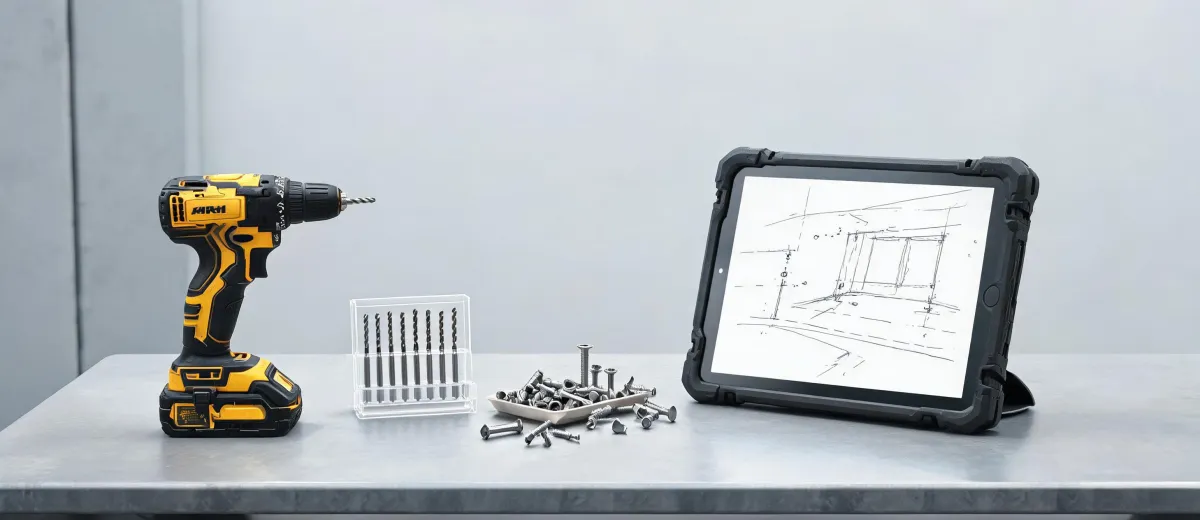
Scenario C: Facility Maintenance & Small Repairs — Where the Wrench and Cordless Drill Come In
-
How to Figure Out Which Scenario You're In
There's No Single "Right" Anchoring Setup—It Depends on the Job
I've been handling procurement for a mid-size construction services company for about six years now. Around $400K in annual tool and fastener spend across maybe a dozen regular vendors. And if there's one thing I've learned, it's that when someone sends me a request for "anchors and a drill," I can't just pick the cheapest option and move on.
That's how I ended up eating an $800 mistake back in 2022. Ordered expansion anchors for a structural concrete pour without checking the load specs. They weren't rated for the application. We had to redo the whole batch. The project manager wasn't happy. My VP wasn't happy. I wasn't happy.
So now I split every anchor and tool request into three buckets before I even open a catalog:
- Structural / high-load anchoring — things that actually hold weight and matter for safety
- General concrete fastening — routine work, moderate loads, standard applications
- Facility maintenance & small repairs — the odd jobs that don't need a full anchoring evaluation
Here's how I handle each one.
Scenario A: Structural Anchoring — Where Hilti HIT-Z Anchor Rods Earn Their Price
If the request involves structural connections, overhead applications, or anything load-bearing, I don't guess. I go straight to Hilti's HIT-Z anchor rods.
Why? Because when you're anchoring into cracked concrete or seismic zones, the adhesive anchor system matters. The HIT-Z rod works with Hilti's HIT-HY 200 adhesive (or similar) to create a bonded anchor that's rated for those conditions. It's not cheap. A box of rods can run $150–$300 depending on size, and that's before the adhesive.
But here's the thing: the alternative isn't "save money." The alternative is potentially failing an inspection or, worse, a safety incident.
I only believed this after we had an engineer flag a mechanical expansion anchor on a job that should've used adhesive. The inspector caught it. We had to pull everything and redo it. That was a $3,200 delay—not counting the schedule impact.
So for anything structural, Hilti HIT-Z is my default. I verify the rod diameter and embedment depth against the engineer's spec, confirm the adhesive cartridge is compatible, and order the whole system together. No mixing and matching.
Scenario B: General Concrete Fastening — Hilti Expansion Anchors (or Alternatives)
For standard concrete anchoring—shelving, equipment mounts, non-critical attachments—Hilti expansion anchors work fine. The KWIK Bolt or HSL3 series is usually what I go with.
But honestly? This is the scenario where I sometimes look at alternatives.
Not because Hilti's expansion anchors are bad—they're not. They're reliable, well-documented, and the load tables are easy to find. But for a job that doesn't need seismic certification or cracked-concrete rating, the price difference can be significant. I've seen comparable expansion anchors from other brands at 30–40% less.
That said—and this is important—I only go with alternatives when:
- The engineer has approved the substitution in writing
- The load requirements are well within the anchor's rated capacity
- The substrate is standard concrete (not cracked, not seismic)
If any of those conditions aren't met, I stay with Hilti. The documentation alone is worth the premium when you need to prove compliance.
Scenario C: Facility Maintenance & Small Repairs — Where the Wrench and Cordless Drill Come In
This is the bucket that surprises people. It's also where I used to waste the most time.
Someone needs a door lock replaced—say, a Philips door lock (yes, that's a brand, not a screwdriver reference). Or they need to tighten some bolts on a piece of equipment. Or they need to drill a few holes for a sign or a rack.
For these jobs, you don't need a Hilti anchoring system. You need a decent wrench and a reliable cordless drill.
We keep a set of standard combination wrenches in the maintenance closet. Nothing fancy—the ones that get lost are never the expensive ones, and that's fine.
For the drill: we've been running an older 1961 cordless drill (that's the model number, not the year—though it feels like it's been around that long) for light-duty work. It's nothing special, but it does the job for small holes and driving screws. When it dies, I'll replace it with something mid-range—probably a Hilti Nuron drill if the budget allows, since we're already in that battery ecosystem for other tools.
As for the Philips door lock: the trick isn't the lock itself—it's making sure you have the right drill bit and the door is properly aligned before you start. I learned that the hard way when I tried to rush a lock replacement and ended up stripping the screw holes. Had to call a locksmith. $180 mistake for something I could've done myself with five more minutes of patience.
The point is: not every job needs the premium solution. Knowing when to spend and when to save is the actual skill.
How to Figure Out Which Scenario You're In
I use a simple three-question filter:
- Does this anchor need to hold something that could hurt someone if it fails? If yes → Scenario A. Hilti HIT-Z and adhesive. No shortcuts.
- Is this a standard application with moderate loads and a clean substrate? If yes → Scenario B. Hilti expansion anchors or an approved alternative.
- Is this a maintenance task or a small repair that doesn't involve structural loads? If yes → Scenario C. Use what you have, replace tools when they break, and don't overthink it.
If you're unsure, ask the engineer or the project lead. That's not a cop-out—it's the job. I've never regretted asking for clarification. I have regretted assuming.
The goal isn't to buy the most expensive option every time. It's to match the solution to the risk. Do that, and you'll keep your projects safe, your budget intact, and your VP off your back.
"Pricing and product availability vary by region and date. Verify current specifications and load ratings with the manufacturer or a licensed engineer before ordering."

Leave a Reply