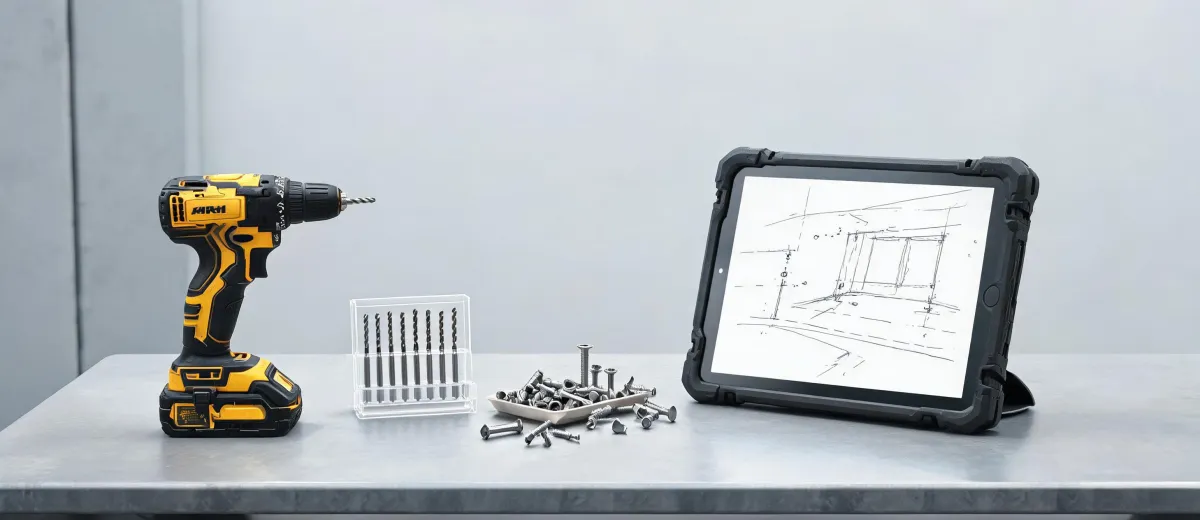
It started as a quiet Monday morning. I grabbed a Hilti hammer drill battery off the charger, walked to the drill, snapped it in, and pulled the trigger. Nothing. Not even a click.
Ten minutes later, I was on the other side of the building with a pressure washer that wouldn’t spray. I had a site to finish, a supervisor asking questions, and the kind of headache that makes you say words you don’t mean. I assumed both problems were random equipment failures.
They weren’t.
I’m a maintenance supervisor who has handled equipment and tool orders for eight years. In my first year (2017), I made the classic mistake of replacing expensive parts without doing any diagnostic work. Since then, I’ve personally documented six significant equipment failures, totaling roughly $4,300 in wasted budget. I now maintain our team’s checklist to prevent others from repeating my errors. I’m also the person who caused most of those failures. That’s the part I usually skip.
The Problem I Kept Treating as the Problem
The dead Hilti hammer drill battery was the obvious problem. To be honest, I didn’t even troubleshoot. I had two hours to decide whether to order a replacement before the next site day, so I did what the schedule demanded: bought the expensive replacement and hoped. Hit “submit order” and immediately wondered whether the charger was the real culprit. The new battery worked, but the doubt never went away until I found the manual.
The pressure washer not spraying was the same story. I replaced the spray gun and nozzle before realizing the water inlet filter was clogged with fine sand. The fix was a $4 o-ring and about thirty seconds of cleaning (note to self: check the basic stuff first). I want to say I spent $60 on parts that didn’t need replacing, but don’t quote me on the exact number.
What I Was Actually Doing Wrong
It took me about four years and a pile of invoices to understand that tool reliability is mostly operator reliability. The deeper reasons weren’t in the tools. They were in my assumptions.
1. I treated the Hilti manual as a legal document, not a diagnostic tool
The Hilti manual had the battery storage recommendation near the beginning. When I first started using Hilti tools, I thought manuals were mostly disclaimers. They aren’t. According to Hilti’s manual archive (hilti.com/manuals, accessed January 2025), Li-Ion batteries should be stored in a cool, dry location and charged at room temperature. They also recommend avoiding deep discharge for long periods. If I’d kept the battery in a climate-controlled toolbox instead of a hot truck, I probably wouldn’t have ordered a replacement. At least, that’s been my experience in building maintenance and light demolition.
2. I confused “it turns on” with “it works”
When the Hilti hammer drill battery died, I tested it with a multimeter and saw voltage. In my mind, that meant it was fine. It wasn’t. A Li-Ion battery can show nominal voltage but drop almost instantly under load. That’s a classic “has electrons, no energy” situation. I should have tested it with a load, not just measured open-circuit voltage.
The same thing happened with the pressure washer. The motor ran, so I assumed the pump was fine. The pump wouldn’t pressurize because the inlet side was starving. The motor’s “turn on” was a lie.
3. I used the wrong storage solution for the environment
This one still embarrasses me. I bought a garden tool caddy to hold spare batteries, chargers, and small hand tools on the job. It was cheap, it had pockets, and it looked organized. It was also never designed for a construction environment. A hammer landed on the charger cord, a pack of screws ended up in the water bottle pocket, and I spent twenty minutes looking for a socket that had slid under the liner. A garden tool caddy has its place. A professional tool storage system is not about looking clean; it’s about protecting your gear and preventing damage.
4. I ignored the safety question until it stared back at me
Then there was the day a new temp on our crew asked, “What are insulated pliers?” I pointed to the red-handled pliers and said, “Those.” That was wrong, or at least incomplete. Insulated pliers are rated to withstand a specific voltage, usually 1000V, and are tested as insulated tools. Rubber-coated handles on generic pliers are not the same thing. The relevant standard is IEC 60900, which covers hand tools for live working up to 1,000V AC. If you have to ask “what are insulated pliers,” you should probably stop and check your tools before doing electrical work.
The Real Cost of Ignoring the Deep Problem
Let me put numbers on it. The Hilti hammer drill battery replacement cost around $245 (this was back in 2023; verify current pricing on hilti.com). The pressure washer parts I didn’t need cost about $60. The wasted trip cost an hour of a technician’s time. The wrong pliers question wasn’t a dollar figure—it was a possible arc flash in someone’s hands.
Across my first two years in this role, the total was close to $4,300. That’s not a catastrophic number in construction budgets. But it’s enough to buy a serious rotary hammer or a set of extra batteries. I’d rather have the equipment than the lesson.
The most frustrating part? None of these failures were mysterious. You’d think after the second one I’d change my process. But routine pressure is a powerful thing. To be fair, not every failure is preventable. Batteries do degrade, pumps do fail, and some tools are genuinely defective. But the failure rate on our crew dropped dramatically once we started doing the boring stuff correctly.
What Actually Changed
I can’t undo the mistakes. What I can do is hand the next person a checklist that keeps me from repeating them. This is the part I wish someone had shown me in my first year:
- Read the Hilti manual before the tool breaks. You don’t have to memorize it. Just know where it is and what troubleshooting sections exist.
- Treat batteries like consumables with rules. Charge at room temperature, store at a partial charge, and retire any pack that won’t hold load. The Hilti hammer drill battery is a good example—it’s powerful, but it’s not indestructible.
- Troubleshoot before you replace. If a pressure washer is not spraying, check the water supply, inlet filter, and hose connections before buying new parts.
- Use the right storage for the environment. A garden tool caddy has its place. Just make sure that place isn’t a commercial job site.
- Ask the safety questions early. Learn what insulated pliers are and when they are required. The answer is not “they have rubber handles.” It’s “they are individually tested insulated tools.”
None of these ideas are mine. They’re in the manuals, in safety orientations, and on the Hilti training site. The problem wasn’t a lack of information. It was my assumption that I didn’t need it.
The next time a tool “fails for no reason,” I try to remember that there’s usually a reason. It’s rarely a dramatic one. It’s a battery left in a hot truck, a water inlet filter clogged with fine sand, a safety question I was too embarrassed to ask, or a storage solution that was great for the garden and wrong for the job site.
I’d rather spend 10 minutes explaining options than deal with the same costly failure twice. An informed customer—or an informed maintenance supervisor—asks better questions and makes faster decisions. That’s not a warm way to close. It’s just the math.

Leave a Reply