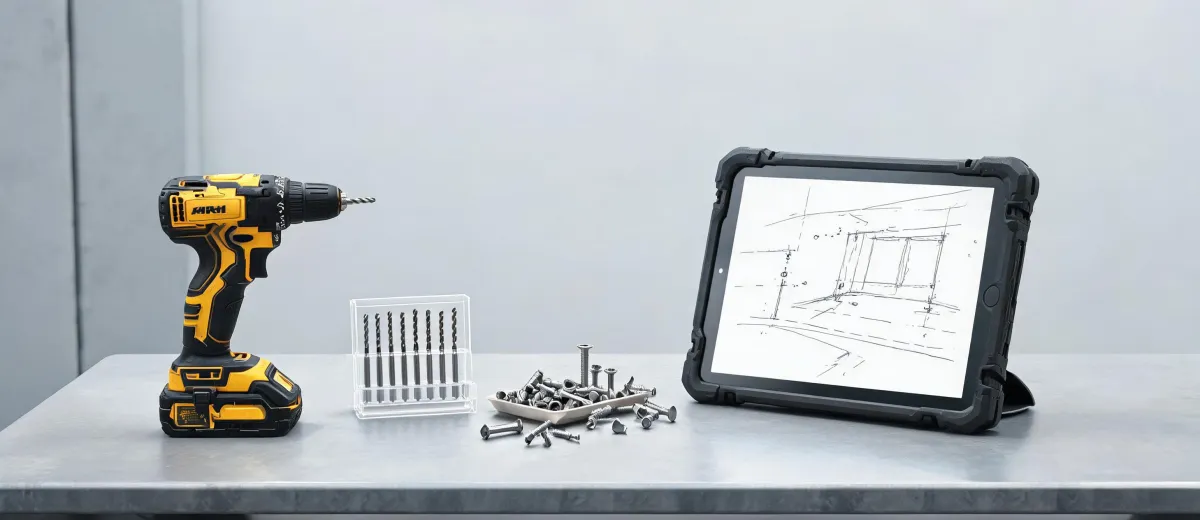
Thursday, 3:40 p.m.: The call that started it
In March 2024, I was three weeks into a new quality protocol at our construction supply company. I'm a quality and brand compliance manager. I review every fastener and tool order before it reaches our crews—roughly 300 line items a month. In our Q1 2024 quality audit, I rejected 12% of first deliveries because the documentation or spec didn't match. That's not a brag. It's a warning.
My phone buzzed. A project manager for a rooftop equipment install. The client had an event on Saturday. We had to anchor a steel rack to a concrete pad by Friday noon. The drawing called for Hilti Kwik Bolts. The supplier we usually use was out of the right size. The PM said, "Can you get Hilti anchors by tomorrow?"
Friday, 7:10 a.m.: The welder’s question
When I got to the site, the welder was already there. He looked at the rack and asked, "How many does a welder use?" I honestly thought he meant welding rods. He meant anchors. He was trying to plan his day. I said, "Depends on the drawing. On this rack, the engineer specified 24 Hilti Kwik Bolts for the main brackets and 12 Hilti screw anchors for the secondary supports."
That's when I noticed something. One of the helpers had a box of Hilti screw anchors open near the primary bracket. I assumed they were interchangeable. Didn't verify. Turned out they weren't.
According to Hilti's technical guide for mechanical anchors, screw anchors and Kwik Bolts are designed for different load paths and base conditions. Screw anchors can be great for lighter, temporary, or secondary connections. Kwik Bolts are typically used where you need higher shear and tension values, and they're tested under ETA and ICC-ES protocols. Same hole? Maybe. Same performance? No.
We stopped the install. That cost us 45 minutes. But it saved us from a much bigger problem.
Friday, 9:20 a.m.: The angle grinder question
While we waited for the correct anchors, one of the guys was cutting an aluminum bracket. He shouted over the noise, "Can you cut aluminum with an angle grinder?" Technically, yes. But not with the wrong wheel and no lubricant. Aluminum gums up standard abrasive discs. It can overheat, bind, and kick back. We switched to a dedicated aluminum cutting wheel and a stick of lubricant. Another 20 minutes gone.
I wasn't mad about the questions. I was mad that we hadn't planned for them. We weren't buying garden hand tools or a gartenschere—different category, different specs—but the same rule applied: verify the spec before you cut or anchor. A gartenschere is simple. A concrete anchor in a structural rack is not.
Friday, 11:05 a.m.: The $400 decision
The local Hilti supplier had the Kwik Bolts, but standard delivery was Monday. Rush delivery by 10 a.m. Friday was $400 extra. I had to decide in five minutes.
I've been burned twice by "probably on time" promises. Once, in 2023, a vendor said a batch of custom brackets would arrive Thursday. They showed up Monday. We missed a $15,000 client event. The redo cost us $22,000. So when the supplier said, "We can guarantee 10 a.m. with the rush fee," I paid it. Not because I like spending money. Because in an emergency, the expensive thing isn't the rush fee. The expensive thing is uncertainty.
Looking back, I should have locked the anchor order two weeks earlier. At the time, the standard delivery window seemed safe. It wasn't. If I could redo that decision, I'd have paid for certainty from the start. But given what I knew then—a drawing that looked clear, a supplier that usually delivered—my choice was reasonable. The problem was the assumption, not the intention.
Friday, 9:30 a.m.: The delivery
The Kwik Bolts arrived at 9:30 a.m. The driver had the paperwork. I checked the boxes against the drawing. Hilti Kwik Bolts, correct size, correct approvals. We used the screw anchors where the engineer specified them and the Kwik Bolts on the main brackets. The welder finished his welds. The torque check passed. We were done by 11:40 a.m.
The client never knew about the $400 fee. They just knew the rack was ready for Saturday. That's the point. The rush fee bought a guarantee. The guarantee bought a calm Friday. The calm Friday bought a happy client.
What I learned (and what I'd tell a new quality manager)
In my first year, I made the classic specification error: I assumed "standard" meant the same thing to every vendor and every product. Cost me a $600 redo on a small order. That was cheap tuition. The anchor mix-up could have cost much more.
Here's what I changed after this job:
- I verify the product family, not just the size. A 1/2-inch Hilti screw anchor is not a 1/2-inch Hilti Kwik Bolt. The load values, approvals, and installation steps are different.
- I answer the welder's question early. "How many does a welder use?" isn't a dumb question. It's a planning question. If the answer is on the drawing, say so. If it's not, get the engineer to put it there.
- I budget for certainty on deadline jobs. The $400 rush fee was 2.7% of the $15,000 event risk. That's a trade I'll make every time.
- I don't confuse simple tools with structural work. Garden hand tools and a gartenschere can be bought on feel. Anchors in concrete need documented load values.
According to Hilti's anchor selection guidance, every mechanical anchor should be chosen by base material, embedment depth, edge distance, and load type. That's not marketing. That's how you keep a Friday from turning into a Monday.
If you're in a rush, don't just ask for the cheapest or the fastest. Ask for the guaranteed. The difference is usually smaller than the cost of missing your deadline.
Leave a Reply