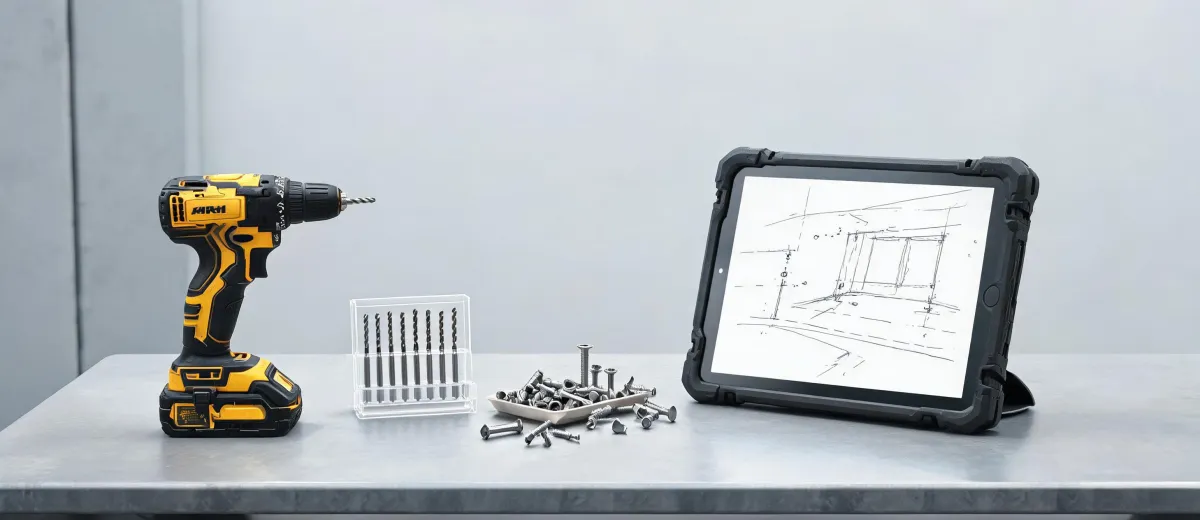
If you've ever tried to make sense of a handwritten tool request and felt your eye twitch, you know the feeling. Last spring, one of our site supervisors sent me this: 'Hilti anchor rods, multi tool Hilti, chainsaw 16, yellow screwdriver.' No part numbers. No quantities. Just that.
I also had a requisition that said 'what is a manual impact driver' in the notes—which, to be fair, was the only thing on the form that was actually a question.
I'm the office administrator for a 75-person construction and maintenance company. I manage about $350,000 a year in purchasing across 8 vendors. I report to operations and finance. My job is to keep the field crews supplied without blowing the budget or getting yelled at. That particular morning, I was doing neither.
Surface Problem: The Reqs Sound Like a Joke
When I took over purchasing in 2020, the running joke in the office was that the field crew ordered tools by 'color and vibe.' A yellow screwdriver. A red drill. The 16-inch chainsaw. It was easy to laugh off. But after the third time a 'yellow screwdriver' turned out to be something a site lead specifically needed for an electrical cabinet torque check, I stopped laughing.
Here's the thing: for me, a requisition is a paperwork problem. For a site lead, it's a memory of a tool that got the job done without calling attention to itself. They aren't writing a spec. They're writing a description of a solution they trusted. That's a different language. A handwritten req without part numbers isn't a red flag in itself. It's a starting point.
What Is a Manual Impact Driver, Anyway?
The phrase 'manual impact driver' got added to one of our safety toolboxes last year. I had to look it up. It's a hand tool that you hit with a hammer to turn a screw—usually a stuck, rusted, or over-torqued screw. The impact from the hammer pushes the driver down and rotates it at the same time. It's not a power tool. It's not a drill. It's the kind of thing you buy once and forget about until you absolutely need it.
'Why don't we have one of those?' the crew lead asked. I didn't have a good answer. It was on nobody's list. It wasn't in our normal tool catalog. And that's the deeper problem: we were ordering what we'd always ordered, not what the job actually required.
Deeper Cause: The Catalog Is Not the Job Site
What most people don't realize is that when a site lead writes 'multi tool Hilti' on a req, they're not trying to be vague. They're asking for the exact oscillating tool that the Hilti rep demonstrated last month. It has a number. It has a battery platform. But to the people in the field, it's just 'the red multi-tool that works.'
Same with 'chainsaw 16.' One of our crews needed a 16-inch bar chainsaw for cutting formwork and lumber on a demolition-adjacent job. In their heads, 'chainsaw 16' was one item. In the purchasing system, it was a 20-page spec sheet with bar length, chain pitch, drive links, battery voltage—things that matter but never make it onto a handwritten note.
To be fair, I get why the field writes things this way. They're not in front of a computer. They're standing in the rain. They need a tool, and they need it fast. The last thing they care about is whether finance can tell the difference between a specified Hilti anchor rod and a post-installed wedge anchor. But finance—and let's be honest, me—can't approve what we can't identify.
The 'Yellow Screwdriver' Lesson
About two years ago, one of our electricians put in a request for a yellow screwdriver. I almost ordered the first yellow-handled screwdriver I found online. Then I asked him why yellow. Turns out the yellow handle was a visual cue that the tool had an insulated shaft, and our safety policy required insulated tools for any work near live panels. The wrong 'yellow screwdriver' would have been a safety issue, not just a paperwork issue.
What felt like a silly request was actually a safety-critical purchase. That changed how I handle every ambiguous line item.
What Wrong Orders Actually Cost
Let's talk about the real cost, because this is where I got burned.
In March 2024, we had a weekend window to install anchor rods for a guardrail system. The crew ordered 'Hilti anchor rods' by that exact phrase, and I bought a generic alternative because it was 30% cheaper and looked close enough. The anchor rods arrived. The installation team did a pull test on Monday. It failed.
The upside was $150 in savings. The risk was a failed inspection. I kept asking myself: was $150 worth potentially getting shut down for a week? The answer was no. The vendor we bought from couldn't provide the same load data, and the engineer on the project wouldn't sign off on it. We had to tear out part of the installation and redo it with the specified material. Rushing the replacement meant overnight freight—about $380—plus six hours of labor. Ballpark? A $150 'saving' turned into roughly $1,900 and a blown deadline.
Here's what you need to know: the number you put into a purchase order is not the cost of the order. It's the start of the cost. If the tool is wrong, if the spec is wrong, if the delivery is late, the real cost is downtime, rework, missed deadlines, and having to explain to your VP why the project is behind.
Time Certainty Has a Price
I don't have hard data on how many hours we lost to bad tool purchases, but based on the last two years of order histories, my sense is it was somewhere in the 40 to 60 hour range annually. That's not dramatic. It's more like death by a thousand small delays.
When you're managing a project with a fixed deadline, 'probably on time' isn't a plan. I've paid an extra $400 for rush delivery at least twice—once in 2023 and once in 2024. In both cases, the alternative was missing a client deadline that would have cost us far more than the shipping premium. This isn't about being extravagant. It's about knowing when certainty is the actual thing you're buying.
I get why people go with the cheapest option. Budgets are real. But the uncertainty of a vendor who 'should be able to get it to you by Tuesday' is a risk you carry. Sometimes the risk is acceptable. When a deadline is contractually fixed, choosing the reliable option is a no-brainer.
The Fix: Buy Certainty, Not Just Hardware
So what changed?
First, I stopped treating every tool request as a product search. I started treating it as a conversation: What are you actually doing? What worked last time? What's the deadline? This sounds obvious, but in the middle of a busy week, it's easy to skip. That one change was a game-changer.
Second, I consolidated more of our tool and fastener purchases with suppliers that offer direct technical support and real delivery commitments. For anchor rods, that meant going back to Hilti and using their online anchor selector to verify sizes and load data. As of January 2025, Hilti's technical documentation is pretty clear about which rod is appropriate for which concrete condition. That's an anchor I can stand behind when the engineer asks. The fact that Hilti sells direct also helps: when a deadline depends on it, I can get a written delivery commitment instead of a vague 'should be there.'
Third, I standardized what I could. For cordless tools, that meant committing to the Hilti Nuron platform—the chargers, batteries, and tools all work together, and the 16-inch chainsaw and the multi-tool use the same battery system. It doesn't solve every request, but it solves a lot of confusion.
And yes, we now own a manual impact driver. It sits in the tool crib. The first time someone used it, the crew lead called me and said, 'Why did we not have this two years ago?' That was a good call.
The yellow screwdriver? Still in use. It has a specific drawer now.
If you've ever been the person who has to decode a field req, here's the takeaway: the names on the form aren't the problem. The problem is when you don't have a reliable way to turn those names into the right tool, on time, with the documentation you need. Getting that right is worth paying for.
Pricing and product specs were accurate as of early 2025. The tool market changes fast, so verify current models and delivery commitments before you place a rush order.

Leave a Reply