-
Step 1: Buy the platform, not just the tool
-
Step 2: Price anchors by installed cost, not cart price
-
Step 3: TCO every cordless kit
-
Step 4: Put the service promise in writing
-
Step 5: Ask the circular saw question—and the questions around it
-
Step 6: Test with a small order first
-
What usually goes wrong
If you're the person who signs off on tool orders for a construction crew, this is for you. I'm a procurement manager at a 40-person mechanical contracting company. I've managed our tool and equipment budget (about $380,000 a year) for 8 years, negotiated with 20+ vendors, and tracked every order in our cost system.
Here's the 6-step checklist I use before buying Hilti tools, anchors, and accessories. It's not the only way, but it's the one that stopped me from making the same mistake twice. This is written for folks like me who need to make a defensible buying decision, not a perfect one.
When I first started managing tool procurement, I assumed the lowest quote was the best choice. Then a lower-priced cordless platform cost us two replacement kits in one year. That math hurt.
Step 1: Buy the platform, not just the tool
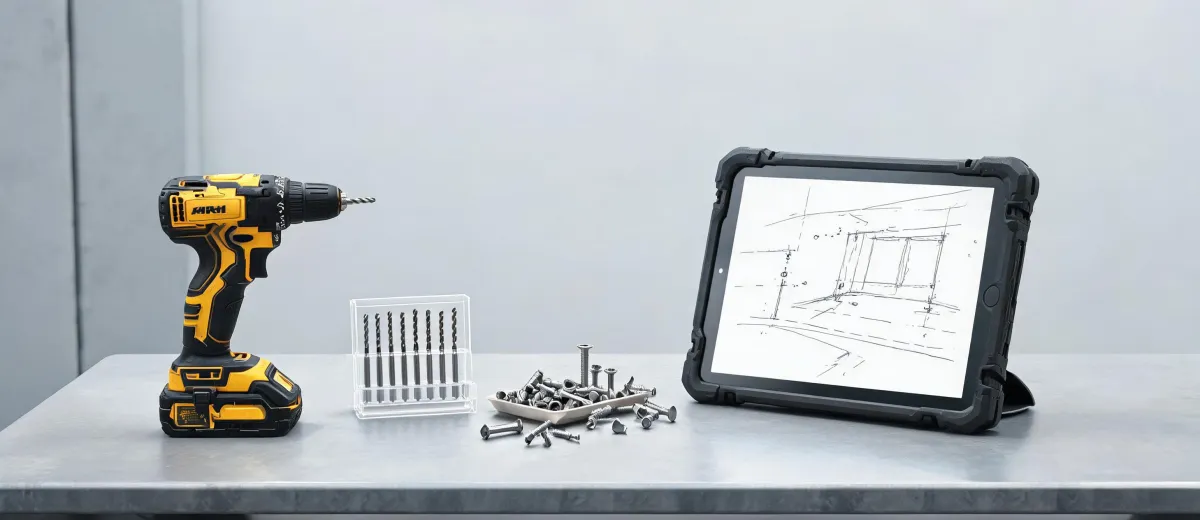
A Hilti cordless drywall screw gun is a good example. The bare tool price matters, but what matters more is whether it runs on the same batteries as the rest of your fleet. Hilti's Nuron platform is designed around shared batteries and chargers, so before you order, list every cordless tool you own or plan to buy. Count batteries, chargers, and truck locations. If you need a cordless drill T18+3 HPC 4.0 i-set kit, check whether the batteries fit the drywall screw gun, the rotary hammer, and the saw. The closer the platform is, the fewer batteries you need to stock.
The cost per battery is not a small line item. If a battery only lasts 18 months on a busy crew, the real cost of a tool includes that battery replacement cycle. So look at the whole platform, not the one-tool price.
Checkpoint: Can this tool share batteries with at least two other tools you already own? If not, you're buying into a new platform, and that's a bigger decision than a single tool order.
Step 2: Price anchors by installed cost, not cart price
I know Hilti HIT-Z anchors get compared on unit price. I do it too. But the unit price is maybe 20% of the real cost.
Here's something vendors won't tell you: the labor to install a fastener often costs more than the fastener itself. If an anchor fails and has to be drilled out and reset, you pay for the anchor twice, plus the labor, plus the delay. I don't have hard data on industry-wide anchor failure rates, but based on our 8 years of jobs, a bad anchor can cost 10 to 30 times its own price in rework.
So when you evaluate Hilti HIT-Z anchors, count drill bits, cleaning supplies, installation time, and crew training. Those are part of the product cost. I also keep the batch numbers and installation notes in our job file, because if something goes wrong later, I need to know what was in that wall.
Checkpoint: What is the installed cost per anchor, not the shelf price?
Step 3: TCO every cordless kit
The cordless drill T18+3 HPC 4.0 i-set is a kit I've ordered more than once. The first time, I compared the kit price to a similar kit from another brand and almost went with the lower-priced one. Then I added replacement batteries, charger slots, downtime, and service turnaround. The difference was a lot smaller than the sticker price suggested. If I remember right, the first kit cost about $1,100 with the i-set case. Don't quote me on the exact number—price sheets change—but the decision logic hasn't.
Here's what you need to know: battery capacity and charger speed matter more than the tool body for long-term cost. If a crew has to stop at lunch because the spare battery is still charging, that's not a free afternoon. Trust me on this one. A 4.0 Ah battery is fine for light work. For a full day of drilling and screw driving, you need to know the actual runtime before you promise a completion date.
I've used the same thinking when buying non-Hilti gear too. When we added welders—MIG welders and a small TIG unit—to the fab shop, I compared machine price, wire feed hiccups, gas cylinder logistics, and repair time. The cheapest welder wasn't the best deal, but the most expensive wasn't either. The one with the shortest downtime was.
Checkpoint: Have you priced two batteries and a fast charger in the total cost? If you're reading a spec sheet, ask how many hours of use you get per charge on real work, not on an empty bench.
Step 4: Put the service promise in writing
Hilti's service model is one of the reasons I keep ordering. But I still ask for warranty and repair terms before I sign. “We'll take care of you” is nice. “Two business days for tool repair in writing” is better.
Per FTC guidelines at ftc.gov/business-guidance/advertising-marketing, advertising claims have to be truthful, not misleading, and substantiated. So if a rep makes a claim about a tool's durability, I ask for it in the product documentation. If it's not there, I don't spend the money on it.
Also ask about loaner tools. If a tool is down for repair and there's no loaner, the cost of renting a replacement can be higher than the repair. That's another line I track in every quote.
Checkpoint: Does the quote list the warranty length, repair turnaround, and who covers shipping? If not, get it in writing before you approve the order.
Step 5: Ask the circular saw question—and the questions around it
I'll say this plainly: why should a circular saw that does not have dust extraction or a blade brake be considered for a production crew? It shouldn't be the main saw. That's not pickiness; it's a safety calculation. A saw without a brake keeps spinning after you release the trigger, and a blade that keeps spinning on a worksite is a cost risk.
But beyond the saw itself, I ask about the extras. Blades, guide rail compatibility, dust bags, replacement parts. Those costs are often ignored in a quote. The same logic applies to drill bits for rotary hammers and core bits for diamond coring. If the consumables aren't in the budget, the tool is not in the budget.
Another thing I check is the saw's dust port and vacuum connection. On structured jobsites, dust rules matter. A saw that blows dust everywhere can slow the crew down and create cleanup hours you didn't plan to pay for.
Checkpoint: Have you priced the top three consumables for each tool before placing the order?
Step 6: Test with a small order first
Small doesn't mean unimportant—it means potential. I still remember our first Hilti order: a cordless drill T18+3 HPC 4.0 i-set, a Hilti cordless drywall screw gun, and a small packet of HIT-Z anchors. It was not a huge order. The Hilti rep still spent time making sure our crew understood the battery setups and the anchor installation basics.
That experience shaped my procurement policy. When we test a new tool, we start with one kit on one crew. If it survives two weeks of real site work, we buy more. If not, we cut our losses. I use the same test for non-Hilti products, like MIG welders. A one-week trial beats a three-year contract every time.
Small orders are also a good way to test support. Who answers the phone? Are parts in stock? Does the invoice match the quote? Those answers tell you more than any brochure.
Checkpoint: Can you order one kit instead of ten? If a supplier makes you feel bad for a small order, that tells you what the next five years will be like.
What usually goes wrong
A few mistakes show up in almost every tool budget I review:
- Buying the bare tool without counting battery and charger costs.
- Comparing anchor price per box instead of installed cost per anchor.
- Ignoring service turnaround until after a tool goes down.
- Forgetting consumables, which is how a low-priced saw becomes a $300 blade problem.
- Letting a small order scare you. We've built a solid relationship with Hilti because they didn't ignore us when we were small.
My experience is based on about 200 tool orders for a 40-person mechanical company. If you're running a 300-person industrial crew, your process will need more layers. But the core checklist holds: platform, installed cost, TCO, service terms, consumables, and a real test.
The goal isn't to find the lowest price. It's to find the tool that costs the least over the next five years while keeping the crew working. That's the checklist I still use.

Leave a Reply