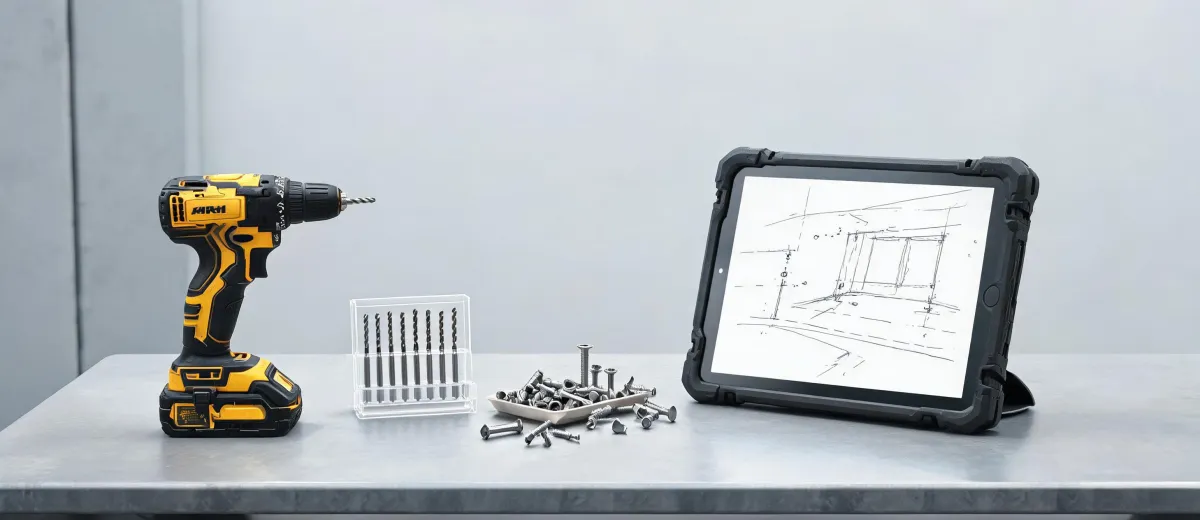
The Fastener Branch: Hilti ZIP Screws vs. Kwik Hus EZ Screw Anchor
If your job involves fastening something, the first question isn't 'Hilti or not'. It's 'what am I fastening into?'
For steel-to-steel and light steel-to-wood, Hilti ZIP screws are the fastest thing in my pouch. They drill, tap, and seat in one pass. (Should mention: I used to say 'one pass' loosely until I learned that the screw's own pilot point does the work. If you lean on it too hard, the point snaps.)
For concrete and masonry, stop. Don't use a ZIP screw in a block wall. That's where the Hilti Kwik Hus EZ screw anchor comes in. You drill a hole in the concrete, set the anchor, and the thread bites into the side of the hole. No hammer-in plug, no expansion clip, no hope. At least, that's been my experience with commercial concrete above 3,000 psi.
So the branch is simple:
- Fastening strut, track, or sheet metal to steel? Hilti ZIP screws.
- Fastening a bracket, handrail, or sill to concrete or masonry? Kwik Hus EZ concrete screw anchor.
- Fastening wood to concrete? Kwik Hus EZ again, with the correct washer and embedment depth.
In 2019, I made the classic mistake: saved $75 on a box of no-name concrete anchors instead of the Hilti Kwik Hus EZ screw anchor. Six of the 48 pulled out during a handrail inspection. The rework cost $1,400 and a fair amount of trust. (Ugh. I still have the email from that general contractor.)
People think the Kwik Hus EZ fails because the load was too high. In my experience, the cause is usually the hole. Dust stays in the hole, the screw anchor never gets full thread engagement, and the anchor pulls out under a fraction of the rated load. Clean the hole, torque it properly, and the load values in Hilti's Anchor Fastening Technical Guide are actually conservative.
One note: I can't quote the load tables here because edge distance, concrete strength, and embedment depth change the numbers. And that's the point. Anchors are not one-size-fits-all, and the person who treats them that way eventually owns a drill-out kit.
The Cutting Branch: Ratchet Cable Cutter, Not the Grinder
For cable, the scenario depends on what you're cutting and where.
If you're cutting copper THHN bundles or aluminum triplex, a ratchet cable cutter is the right tool. The mechanical advantage lets one person cut up to 4/0 or bigger without a power source. It leaves a clean, square end, and it's safe in an electrical panel because there are no sparks.
If you're cutting armored cable, MC, or solid threaded rod, check whether the cutter is rated for steel. Some cable cutters have jaws for copper and aluminum only. If the cutter can't handle it, a grinder with a thin cut-off wheel is the usual fallback. That's not wrong, but secure the material and wear a face shield.
The mistake that changed my routine: I was cutting 4/0 copper in a hurry and used an angle grinder because my battery cutter was charging on the other side of the building. The burr caught a rubber glove and nearly dragged the conductor into a live lug. Nothing happened, but it was stupid. Now I keep a manual ratchet cable cutter in every service bag.
The surprise wasn't that the grinder could handle the copper. It was how much more time I spent cleaning the burr than I would have spent using the cutter. (Honestly, the ratchet cutter is also lighter than my grinder.)
Can I Use an Angle Grinder to Sand Wood? Yes, but It Depends.
Yes, you can. The better question is whether you should. That depends on the finish you're chasing.
Scenario 1: you're stripping paint or shaping a rough edge. An angle grinder with a flap disc or sanding disc removes material fast. I've done it on cedar beams before sealing. It works if you keep the grinder moving and don't press down.
Scenario 2: you're prepping a wood surface for a clear finish, or you want flat, smooth boards. Do not use an angle grinder. The disc creates swirl marks and grooves that are brutal to remove. This is where a belt sander or orbital sander is the right call. (Should mention: dust collection matters more than you'd think. A grinder throws sawdust and finish in every direction, including your eyes. Oh, and put a drop cloth down. Trust me.)
People think angle grinders on wood are dangerous because of kickback. The real hazard is the depth of cut. At 8,000 rpm, a 4-1/2 inch disc can turn a small mistake into a structural groove in under a second. That's how you end up with a 'reclaimed' look you didn't choose.
The mistake I catch on jobsites is people using an angle grinder because it's the only power tool in the shop. Then they spend the next two weekends sanding out the gouges. I've been that person. It isn't cheaper.
The Framing Hammer Branch: FatMax Framing Hammer 51-021
Now the tool that looks out of place in a Hilti conversation: the Stanley FatMax framing hammer 51-021. It's not a Hilti. That's fine.
Hilti's world is drilling, fastening, cutting, and anchoring. A framing hammer is a hand tool. When I'm building wood walls, I reach for the FatMax because it does that one job well. It's an example of the 'know your limits' principle: the best tool is the one designed for the task, not the one that matches the color of your other gear.
The 51-021 has been in my bag since 2018. (Which, honestly, is more than I can say for my first hammer. I left that one on a roof.) It drives nails without bouncing the handle, and it gives me the weight I want for framing. If you only do occasional wood framing, a cheaper hammer will work. If you frame every week, the FatMax is worth the spot on the truck.
How to Know Which Branch You're In
Don't memorize the tool names. Memorize three questions.
- What is the substrate? Steel, wood, concrete, masonry, or cable? If you can't name the substrate, you're not ready to choose the fastener.
- What is the operation? Driving, anchoring, cutting, or shaping? A drill, an impact driver, an anchor, and a grinder are not interchangeable.
- What does failure cost? If the fastener pulls out, the cable nicks, or the wood burns, what's the total damage? If it's more than the price of the right tool, buy the right tool.
Since I put this checklist on the wall, I've caught 47 potential errors in 18 months. I'm not saying that to impress you. I'm saying it because each one was a version of 'I almost used a ZIP screw in concrete' or 'I almost grabbed the grinder for cable.'
So, to summarize: an angle grinder can sand wood, but only for shaping. Hilti ZIP screws are for steel. Kwik Hus EZ is for concrete. A ratchet cable cutter is for conductors. The FatMax 51-021 is for framing. None of them is a universal answer, and that's exactly why my checklist works.
If a vendor tells you one tool does all of this, walk away. Specialists have limits. That's not a weakness; it's a sign they know what they are for.

Leave a Reply